The most common concern I hear from homeowners when they enquire about worktop restoration is this: "Won't sanding the worktops cover the entire kitchen in dust?" It's a completely understandable worry. The image of someone belt-sanding a floor and covering everything in a thick white fog is hard to shake. But with professional dust-free sanding technology, that scenario simply does not happen.
Here's what dust-free sanding actually means, how the technology works, and why it matters not just for keeping your kitchen clean but for the quality of the finished result.
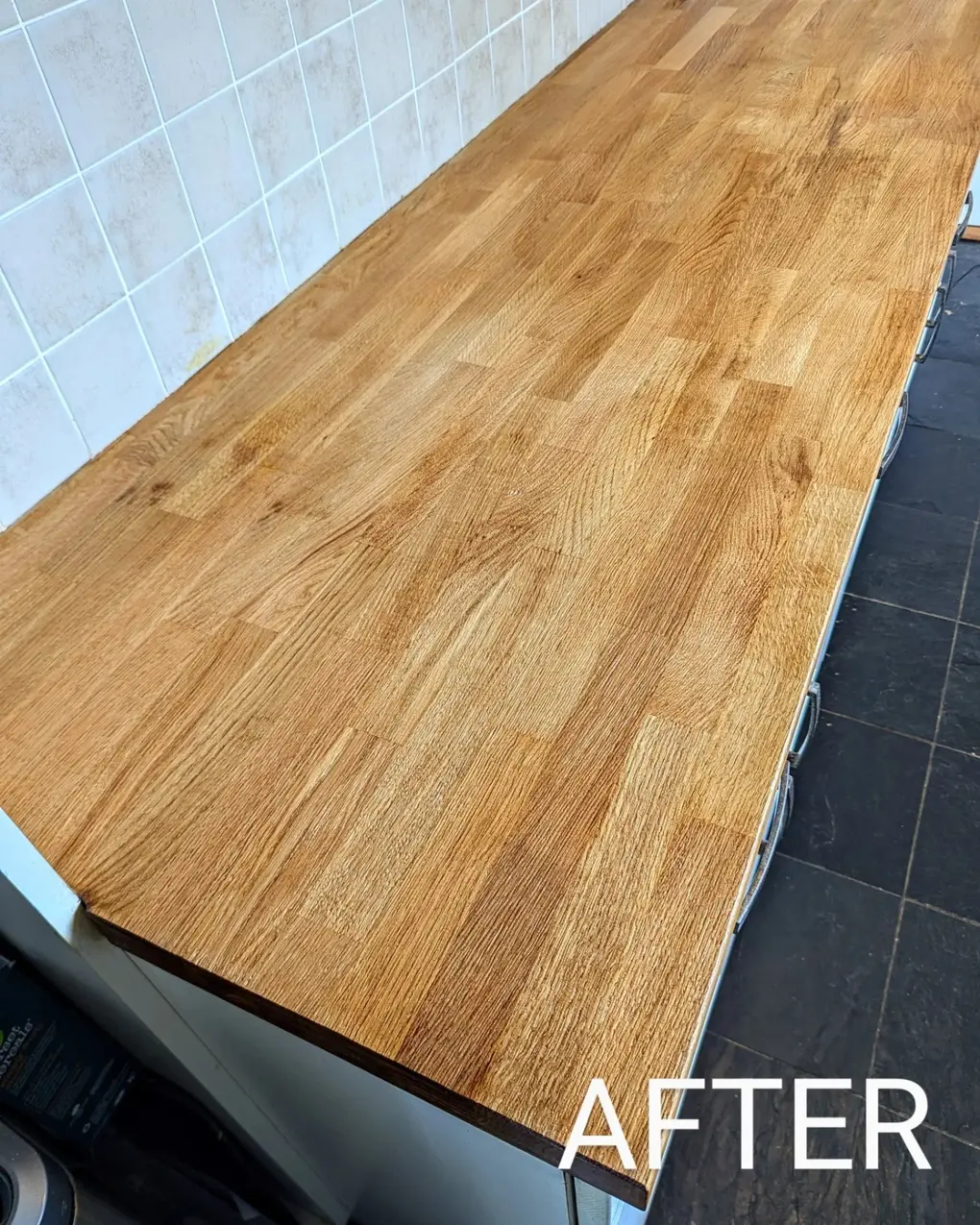
What Is Dust-Free Sanding?
Dust-free sanding is a method where the sanding machine is connected directly to a vacuum extraction unit via a sealed shroud or integrated dust port. As the abrasive removes material from the wood surface, the resulting dust is immediately captured and drawn into the vacuum — before it can become airborne.
Professional dust-free systems use HEPA filtration, which captures particles down to 0.3 microns. To put that in context: fine sanding dust typically ranges from 1 to 100 microns. HEPA filtration captures effectively all of it, including the very fine particles that cause the most health concern and that ordinary vacuum bags allow to pass through.
The result: The sanding machine produces virtually no visible dust cloud. Your kitchen cabinets, worktops, appliances, and the rest of your home remain clean throughout the entire restoration process.
Professional vs DIY: How Extraction Compares
Most DIY orbital sanders sold in hardware stores have a small dust bag or a basic port to connect a domestic vacuum cleaner. These capture a fraction of the dust produced. Here's how professional dust-free extraction compares to common alternatives:
| Method | Dust Capture Rate | HEPA Filtration | Kitchen Stays Clean |
|---|---|---|---|
| Professional dust-free system (Ashley uses) | ~99%+ | Yes | Yes |
| DIY sander with dust bag | ~40–60% | No | No |
| DIY sander with domestic vacuum | ~60–75% | Rarely | No |
| No extraction (open sanding) | 0% | No | No |
The gap in performance is significant. A DIY sander with a dust bag might capture 40–60% of the dust produced — meaning 40–60% of it goes into the air in your kitchen. With a professional HEPA extraction system, that figure drops to under 1%.
Why Dust-Free Sanding Also Improves the Finish Quality
The cleanliness benefit is the obvious one, but dust-free extraction also has a direct impact on the quality of the finished result — for two reasons.
1. Cleaner Working Surface
When dust accumulates on the surface being sanded, it acts as a cushion between the abrasive and the wood, reducing cutting efficiency. The abrasive starts to skip over the surface rather than cutting cleanly into it. Continuous extraction keeps the surface clear and allows each grit to cut consistently and produce the smooth, even surface that the oil can penetrate evenly.
2. No Contamination Before Oiling
When the sanding is complete, any dust left in the wood grain must be fully removed before oil is applied — otherwise it gets sealed in and creates tiny blemishes in the finished surface. With dust-free extraction throughout the sanding process, there is far less residual dust to deal with, which means a cleaner, more consistent oil penetration and a superior final result.
Health Protection
HEPA filtration protects both the occupants and Ashley himself from fine wood dust, which is classified as a respiratory hazard with prolonged exposure.
No Pre-Clearing Required
You don't need to empty your kitchen before the job. Plates, glasses, food items, and appliances can all remain in place — they won't be covered in dust.
Faster Clean-Up
Because the extraction is so effective, clean-up at the end of the job is quick. There's no cloud of settled dust to wipe off every surface in the kitchen.
Better Oil Penetration
A clean, dust-free surface allows Osmo Polyx-Oil to penetrate evenly into the wood grain, producing a more consistent colour and better long-term protection.
The Difference This Makes in Your Home
To make this concrete: here's what a typical professional restoration looks like in your kitchen compared to what a DIY sanding job without proper extraction looks like.
With professional dust-free equipment (Coedwig Creations):
- The sanding machine creates a low-level hum — no visible dust cloud
- The kitchen surfaces, cabinets, and appliances remain visually clean throughout
- At the end of the job, a light wipe-down is all that's needed
- No dust in other rooms, no dust on furniture or soft furnishings nearby
With a DIY orbital sander and no effective extraction:
- A visible cloud of fine dust fills the kitchen within minutes
- Dust settles on every horizontal surface in the kitchen and adjacent rooms
- Fine particles penetrate into cupboards, onto crockery and food
- Hours of cleaning needed after the sanding before oiling can even begin
- Fine dust in the air for hours, presenting a respiratory health hazard
This is one of the key reasons why worktop restoration genuinely is a job best left to a professional with the right equipment — not because the technique itself is impossible to learn, but because the investment in proper extraction equipment alone costs more than most homeowners would spend on a one-off DIY project.
A Note on Health and Safety
Fine wood dust — particularly hardwood dust from species like oak, walnut, and iroko — is classified by the Health and Safety Executive (HSE) as a substance hazardous to health. Prolonged unprotected exposure is associated with respiratory issues and, in some cases, occupational asthma. Professional dust-free extraction eliminates this risk for both the specialist doing the work and the occupants of the home.
If you ever see a tradesperson sanding your worktops without dust extraction, it is worth asking about the health implications — both for them and for you and your family.
Getting a Quote
If you're in South Wales and your solid wood worktops need restoring, the process is simple: WhatsApp me a few photos of your worktops along with your postcode. I'll come back to you with a price, usually the same day.
I cover all of South Wales from Llanharry — including Cardiff, Swansea, Newport, Bridgend, Pontypridd, the Vale of Glamorgan, Penarth, and beyond.
For a complete picture of the restoration process — all nine steps from initial assessment to final clean-up — read my guide: What Happens During a Professional Wood Worktop Restoration?
Frequently Asked Questions
Is sanding wood worktops a messy job?
With professional dust-free sanding equipment, no. The machines Ashley uses capture virtually all sanding dust at source via HEPA-filtered extraction. Your kitchen and surrounding rooms remain clean throughout.
Do I need to empty my kitchen before the restoration?
No. You don't need to remove crockery, food items, or appliances from your kitchen. Ashley protects the immediate work area before sanding begins, and the dust-free extraction means the rest of your kitchen stays clean.
What is HEPA filtration?
HEPA stands for High Efficiency Particulate Air. HEPA filters capture 99.97% of particles 0.3 microns and larger. This includes the very fine wood dust particles that standard vacuum bags allow to pass back into the air. Professional dust-free sanding systems use HEPA filtration throughout.
Can I hire dust-free sanding equipment to do this myself?
Professional dust-free sanding equipment with HEPA extraction can be hired from specialist tool hire companies, though it's significantly more expensive than standard orbital sanders. However, even with the right equipment, the technique — knowing which grit progression to use, how to handle joins and edges, when to hand-sand, and how to apply oil correctly — takes experience to get right. Most homeowners who attempt DIY restoration end up calling a professional anyway, having already spent money on hire costs.
Is wood dust from kitchen worktops harmful?
Fine hardwood dust — from species like oak, walnut, and iroko — is classified by the HSE as a substance hazardous to health. Professional HEPA extraction eliminates this risk during the restoration. Once the oil is applied and cured, the worktop surface is completely safe.