Not sure if your worktops need professional attention, or whether a DIY product will do? As South Wales' dedicated solid wood worktop restoration specialist, I see the same types of damage over and over again — and I can tell you that once certain signs appear, DIY products will not produce results you will be happy with. Here are the five key signs that it is time to call in a professional.
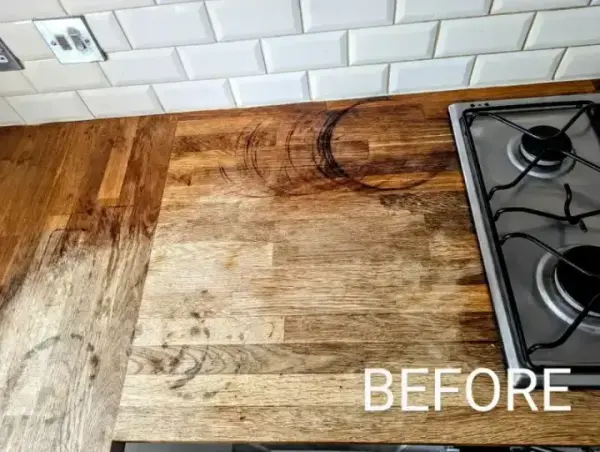
Your Worktop Has Gone Grey or Dull All Over
This is the most common sign — and one that homeowners often mistake for the wood being permanently damaged or "dead." In reality, a grey, dull solid wood worktop is simply showing oxidised, UV-bleached surface wood where the protective oil finish has been depleted.
The good news: greying and dullness are among the easiest things to address through professional restoration. The oxidised surface layer is sanded back to reveal the fresh wood below — which is still the same rich, warm tone it was when first installed. A fresh application of Osmo Polyx-Oil locks in the colour and creates the satin sheen that makes a kitchen worktop look genuinely new.
Why DIY won't work: Applying oil on top of a grey, oxidised surface just makes the grey slightly darker. It does not strip back the oxidised layer or restore the original colour. Professional sanding is essential to achieve this result.
Visible Scratches That Are Easy to Feel With Your Fingernail
Surface scratches — the kind that catch your fingernail — are firmly in professional restoration territory. They are too deep to be "oiled away" with any product, but they are exactly the type of damage that professional sanding addresses with complete success.
Ashley assesses scratch depth when quoting. Scratches that go into the grain (not just the oil finish) can be fully sanded out, leaving the surface smooth and flat. Deep gouges may require specialist wood filler techniques before sanding, but even these can usually be made invisible in a skilled professional restoration.
Why DIY won't work: No oil-based product fills or removes scratches. Coloured wax products that "hide" scratches look acceptable for days, then the scratch reappears as the wax wears away. Only mechanical removal through sanding actually solves the problem.
Water Marks or Black Staining Near the Sink
The area around the kitchen sink is the most vulnerable part of any solid wood worktop. Persistent moisture exposure — from splashing, wet dishes, a poorly sealed sink edge — penetrates a depleted oil finish and works its way into the grain.
Early water marks (white, ring-shaped marks) indicate surface-level moisture and are fully removable through sanding. Black water marks are more serious — they occur when moisture has penetrated deeply enough to trigger a chemical reaction with the tannins in the wood. These are still restorable in most cases, but require a professional assessment.
Why DIY won't work: The moisture and the staining are within the wood fibres. No surface treatment reaches this layer. Only sanding back to below the stain level and re-oiling provides a permanent solution.
A Burn Mark or Heat Damage
Burn marks — from a hot pan placed directly on the worktop, a hot cup, or a lit cigarette — are among the most alarming forms of damage to see. Many homeowners assume burn marks mean the worktop is ruined.
In the majority of cases, burn marks can be fully removed through specialist sanding. The depth of the mark determines the approach. Superficial burns that have only affected the oil surface and the very top fibres of the wood come out easily. Deeper char that has carbonised the wood requires careful progressive sanding to remove the damaged layer completely. Very deep burns (rare from normal kitchen accidents) may require targeted treatment, which I assess on quoting.
Why DIY won't work: No product removes carbonised wood. Only mechanical sanding can remove the damaged material.
The Worktop Has Had DIY Oil Applied Over Damage
This one is very common — and it actually makes the professional restoration job more involved. A homeowner notices their worktop looking worn, buys a bottle of Danish oil from a hardware store, and applies it. The result looks better for a few weeks, then returns to looking worn — because the underlying damage was never addressed, and because Danish oil does not have the hardness or durability of professional-grade hardwax oil.
If your worktop has multiple layers of DIY oil applied over time — especially if it includes a varnish or a water-based coating — the professional restoration involves stripping these coatings back through more aggressive initial sanding before the grain is properly cleaned and a professional finish is applied. This is absolutely achievable, and it produces the same excellent results — it just takes slightly longer.
The lesson: If you are reading this before applying a DIY product, WhatsApp Ashley for a quote first. A professional restoration will always produce a better result than a DIY application — and it may cost less than you expect.
When Should You Consider Replacement Instead?
In Ashley's experience, the situations where replacement genuinely makes more sense than restoration are rare but do exist:
- Severe structural warping or cupping that has lifted the worktop from its supports — this is a structural issue that restoration cannot address
- A worktop that has developed significant rot from prolonged water exposure (usually where a sink seal has failed for years unnoticed)
- A worktop that the homeowner simply wants to change as part of a full kitchen redesign
In all other cases — which covers the vast majority of enquiries we receive — restoration is the right choice. If you are uncertain whether your specific situation calls for restoration or replacement, WhatsApp Ashley on 07873 536 738 with photos. He will give you an honest assessment, including his professional opinion on whether restoration will achieve the result you want.
Frequently Asked Questions
Can scratches be removed from solid wood worktops?
Yes. Surface and medium-depth scratches can be fully removed through professional sanding. Even deep scratches that have penetrated well into the wood grain can usually be eliminated in a professional restoration.
Can water marks be removed from wooden worktops?
Yes in most cases. White water marks and grey water marks are typically fully removable through sanding. Black water marks caused by prolonged deep moisture penetration can also usually be removed, though the depth of penetration is assessed on a job-by-job basis.
Is a grey, dull wood worktop beyond restoration?
No. Greying and dullness are among the easiest issues to address through professional restoration. The grey surface is simply oxidised, UV-bleached wood that is sanded back to reveal the fresh wood beneath, which is then re-oiled to restore the original colour and sheen.
Can a worktop that has been varnished be restored?
Yes. A varnished worktop requires slightly more initial sanding to remove the coating, but the result is the same. We frequently restore worktops that have had varnish, water-based coatings, or multiple layers of DIY oil applied.

Founder of Coedwig Creations and South Wales' dedicated solid wood worktop restoration specialist, serving Cardiff, Swansea, Newport, Bridgend and the wider South Wales area.